Surely you realize just how important exercise is to get optimally healthy. I started exercising regularly about 45 years ago, and in my own journey, I’ve made many mistakes along the way.
By sharing them, hopefully you can avoid making the same mistakes I made.
One major mistake was not realizing the profound benefits of high intensity exercises.
Walk into a typical fitness center, and you will see the vast majority of people making this same mistake: They’re only using the cardio equipment.
Worse yet, they’re oftentimes reading a book or chatting while doing low intensity training. While this is certainly better than doing nothing, it’s only providing a fraction of the benefits that are possible if you’re using the cardio equipment effectively, and exercising more efficiently.
The way you use cardio equipment properly is by doing HIGH INTENSITY workouts. If you only have 30 minutes, you can easily complete a high intensity interval workout session.
Intensity is Key!
The key factor that makes interval training so effective is intensity. To reap maximum results, you need to work out at maximum intensity, with rest periods in between spurts. You can get an idea of what that looks like by watching my two videos below, in which I demonstrate Peak Fitness exercises using an elliptical machine and a recumbent bike.
While you can do Peak Fitness exercises on virtually any piece of cardio equipment, I don’t recommend using a treadmill as it can be a bit dangerous due to the speeds involved. It takes much longer both to get up to maximum speed, and to slow down, and when you’re tired and can’t decrease the speed fast enough, you might get injured. On the bike or elliptical, you can instantly slow down, which makes it much safer.
Although you could do these exercises outdoors as well, specifically sprinting, I would strongly advise against it without proper instruction on how to avoid injury. When I first started, I did sprints and I ended up pulling my hamstring. It took me nearly a year to fully recover. Sprinting is such an enormous force on hamstrings that unless they are very flexible, there is a great chance you can sprain them or other leg muscles.
Core Principles of High Intensity Interval Training
Here’s a summary of what a typical peak fitness routine might look like:
- Warm up for three minutes
- Exercise as hard and fast as you can for 30 seconds. You want to get your heart rate up to your calculated maximum heart rate. The most common formula for this is to subtract your age from 220. You should be gasping for breath and feel like you couldn’t possibly go on another few seconds
- Recover for 90 seconds, still pedaling, but at slower pace and decreased resistance
- Repeat the high intensity exercise and recovery seven more times, for a total of eight repetitions
This takes exactly 20 minutes and requires just FOUR minutes of all out exercise. I typically cool down for another three to five minutes, and use a functional parameter of my heart rate. I like to get my heart rate down to around 120 before I stop, which gives me enough time to recover. I highly recommend using a heart rate monitor when doing these exercises as it is VERY difficult to accurately measure your heart rate without one.
How Often Should You Do High Intensity Exercises?
If this is the only type of exercise you are doing, you can probably do it three times a week and be fine. However, if you’re also doing strength training, three times a week may be too much. Personally, after doing this for a few years, my rhythm is to do a high intensity Peak Fitness workout on the elliptical once a week and two weekly strength training workouts. I go up to three Peak Fitness workouts a week if I don’t have access to weight equipment when I am traveling.
Recovery is another key factor of high intensity workouts. Many simply don’t give themselves enough time to recover, which can be counterproductive. I made that mistake, which is why I cut back on my frequency. If you’re competing, you can certainly increase the frequency, but if you’re exercising to get healthy and live longer, then make sure to give yourself sufficient recovery time in between.
This brings up an interesting point… You can optimize your exercise in two ways:
- To achieve extreme fitness for competition, OR
- To promote longevity and perhaps fertility
Sad to say, this is an area where you simply cannot “have it all.” You have to choose your end goal. For example, female professional athletes will oftentimes have difficulty getting pregnant, and this is because they’ve altered their bodies to achieve maximum fitness (which includes low body fat and high muscle mass), forgoing optimal fertility in the process (women need body fat in order to produce female hormones).
To become fertile again, she must tone down her fitness routine and modify it so she can gain a higher percentage of body fat. Part of the problem is your body is very smart and will not allow you to get pregnant if it is not convinced there are enough calories present to support another life, and part of the way it does this is by monitoring your percentage of body fat.
You Can Super-Charge Your Weight Training Too!
I believe that nearly everyone should do some strength training, regardless of age. By aggressively working your muscle to fatigue, you’re stimulating muscular adaptation that will improve the metabolic capability of your muscle and cause them to grow. There are many different ways you can go about lifting weights, but one version that seems to work well for many people is called Super-Slow Weight Training. By slowing everything down, you’re actually turning it into a high intensity exercise. The super-slow movement allows your muscle, at the microscopic level, to access the maximum number of cross-bridges between the protein filaments that produce movement in the muscle.
I recommend using four or five basic compound movements for your exercise set. One sample set could be:
- Pull-down (or alternatively chin-up)
- Chest press
- Compound row (A pulling motion in the horizontal plane)
- Overhead press
- Leg press or squat
These exercises can be done using either free weights or machines. The benefit of using a quality machine is that it will allow you to focus your mind on the effort, as opposed on the movement. Select a weight that is light enough so you can do at least eight repetitions, but heavy enough so you can’t do more than 12. If you can squeeze out more than a dozen reps, then switch to a heavier weight. Here’s a general summary of how to perform each exercise:
- Begin by lifting the weight as slowly and gradually as you can. In the featured video, I demonstrate doing this with a four-second positive and a four-second negative, meaning it takes four seconds, or a slow count to four, to bring the weight up, and another four seconds to lower it. (When pushing, stop about 10 to 15 degrees before your limb is fully straightened; smoothly reverse direction)
- Slowly lower the weight back down to the slow count of four
- Repeat until exhaustion, which should be around four to eight reps (once you reach exhaustion, don’t try to heave or jerk the weight to get one last repetition in. Instead, just keep trying to produce the movement, even if it’s not ‘going’ anywhere, for another five seconds or so. If you’re using the appropriate amount of weight or resistance, you’ll be able to perform four to eight repetitions)
- Immediately switch to the next exercise for the next target muscle group, and repeat the first three steps
This workout will take no more than 12 or 15 minutes. For a demonstration, please see the featured video at the top of this article. Please note that I am NOT demonstrating classic Super-Slow training, but rather hybrid version that uses a count of four rather than the standard ten-count, which is still far slower than most people lift weights.
The Barbell Squat – King of Strength Training Exercises
Many consider the barbell squat to be the KING of strength training exercises. It will rapidly push you to anaerobic metabolism because you are using so many of your muscles. It can give you great abs, increase your vertical jump, your functional strength, and your sprint times. It can also increase the strength of nearly all the muscles in your body because of its powerful effects on stimulating growth hormone. Other health benefits boosted by the squat can include:
- Reduced body fat
- Better sleep
- Increased endorphin production (natural pain killers)
- Increased bone density
Make sure to widen your base by spreading your feet apart in a comfortable stance. Also, for safety’s sake, stay inside the power rack frame. That way, if anything should go wrong and you fall or drop the weights, the bar will catch them. If you’re doing a free-weight squat then I would strongly recommend using a trained spotter. This is less necessary on a Smith machine but still a good idea.
The downward portion of the lift always begins with your hips moving backward first. If you bend your knees first, you set yourself up for problems in the middle and end of the lift by causing you to have to adjust for your flexed knees… Moving your hips and buttocks to the rear will align your body to perform the squat perfectly. This can be difficult to do if you have decreased hip flexibility. I certainly did when I first started doing them and it took me a long time to change that. Ideally, have a trained professional guide you.


 In today’s world toxins are unavoidable – they are in the food we eat and the water we drink, as well as the air we breathe.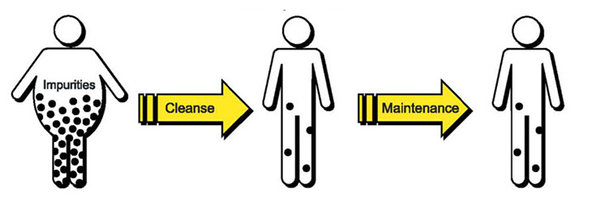
 People who have used this Cleanse and Fat Burning System for nine days have resulted in an average weight loss of seven pounds*.
